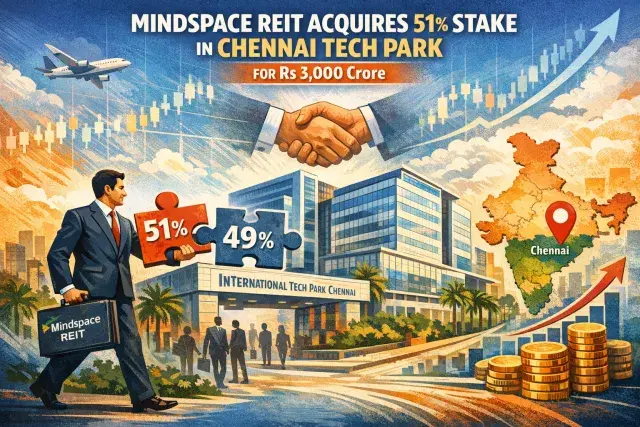
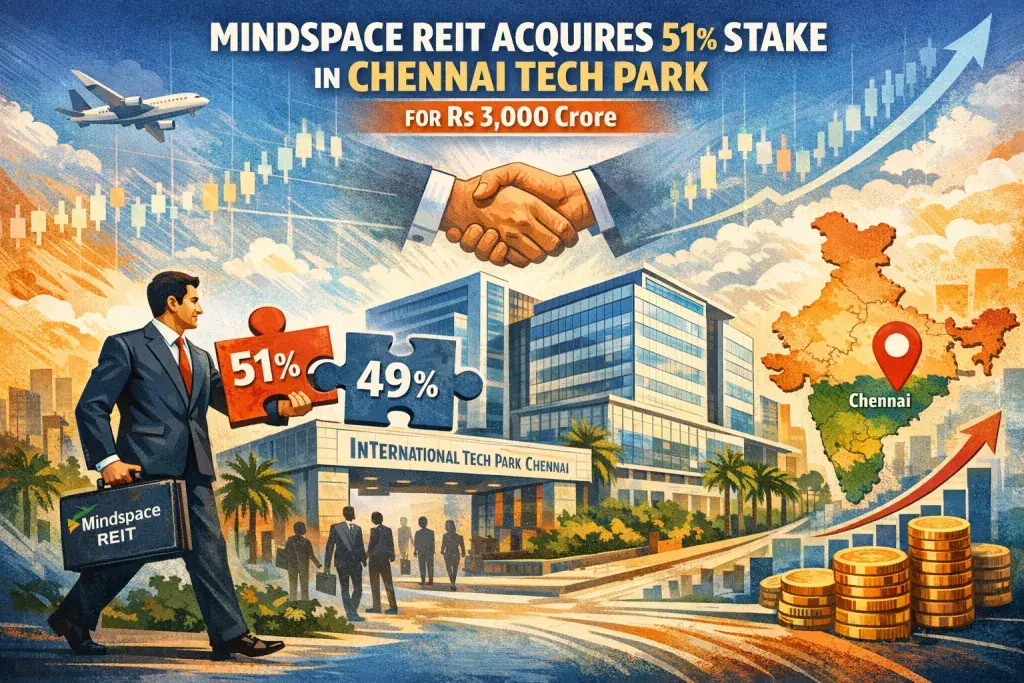
Mindspace Business Parks REIT has secured a 51% stake in the International Tech Park Chennai, Radial Road — a 2.6 million square foot Grade A office complex — in a deal valued at Rs 3,000 crore, marking one of the largest single commercial real estate transactions Chennai has seen. The acquisition comes from AIGP2 Chennai 1, a wholly owned subsidiary of CapitaLand India Growth Fund 2, with 360 ONE Asset's real assets funds retaining the remaining 49% interest. The deal consolidates Mindspace REIT's rapidly expanding footprint in India's fourth-largest office market.
A Calculated Push Into Chennai's Commercial Core
This transaction follows closely behind Mindspace REIT's earlier acquisition of Commerzone Pallikaranai, also in Chennai, a 2.6 million square foot asset acquired for Rs 2,541 crore. Within a short period, the trust has absorbed over five million square feet of premium office space in a single city — a concentration of capital that signals both conviction in Chennai's long-term office demand and a deliberate strategy to establish dominant ownership in key southern markets.
Ramesh Nair, MD and CEO of Mindspace REIT, described the acquisition as positioning the trust among the largest owners of commercial office assets in Chennai. The ITPC – Radial Road asset, acquired from a fund under CapitaLand Investment, adds institutional weight to a portfolio that spans multiple cities across India. CapitaLand Investment, a Singapore-headquartered real estate investment manager with a significant India presence, has historically developed and operated tech parks across the country's major IT corridors.
Why Chennai's Office Market Commands Institutional Attention
Chennai has emerged as one of India's more resilient office markets, underpinned by a dense concentration of global technology firms, engineering services companies, manufacturing multinationals, and financial services operations. The city's talent pool, anchored by a strong engineering and technical education ecosystem, has made it a preferred base for both captive offshore centres and pure-play IT services delivery.
Grade A office demand in Chennai has remained structurally supported even through periods of broader market uncertainty, partly because the city's occupier mix leans toward long-tenure, contract-driven tenants rather than short-cycle startups. For a listed REIT — which distributes income to unitholders and depends on stable, contracted rental cash flows — this tenant profile is precisely what makes Chennai attractive. Large, well-leased tech parks with established tenants provide the kind of predictable income that supports consistent distributions.
The REIT Structure and What This Deal Means for Unitholders
Real Estate Investment Trusts in India operate under a regulatory framework overseen by the Securities and Exchange Board of India. They are required to distribute a significant proportion of net distributable cash flows to unitholders, making acquisition quality directly consequential for investor returns. When a REIT acquires a yielding asset — one that is already leased and generating rental income — the accretion to distributions depends on the yield at which the asset was purchased relative to the trust's cost of capital.
The structure of this deal, with 360 ONE Asset's real assets funds holding 49%, means Mindspace REIT holds a controlling stake while sharing the asset's capital requirement with a co-investor. This approach — acquiring majority control without absorbing the full acquisition cost on the trust's balance sheet — is a recognised method for expanding a REIT's asset base while managing leverage. It also reflects a broader maturation of India's institutional real estate market, where co-investment structures are increasingly common on large transactions.
Implications for Chennai's Office Landscape
The consolidation of major tech parks under listed REIT ownership has structural implications for how office assets are managed and priced in the city. Institutional ownership typically brings professional asset management, higher maintenance standards, and more transparent leasing practices — factors that can raise the benchmark for occupier expectations across a submarket. As Mindspace REIT becomes one of Chennai's dominant office landlords, its leasing strategies, rental pricing, and capital expenditure decisions will carry weight across the broader market.
For occupiers already in ITPC – Radial Road, the ownership transition to a listed REIT brings a different kind of counterparty — one subject to public disclosure requirements, regulatory oversight, and unitholder scrutiny. That transparency can be an advantage for corporate tenants managing their own real estate governance. For the city's office market overall, the sustained flow of large-scale capital into Grade A assets reinforces Chennai's standing as a serious institutional real estate destination in India's commercial property hierarchy.