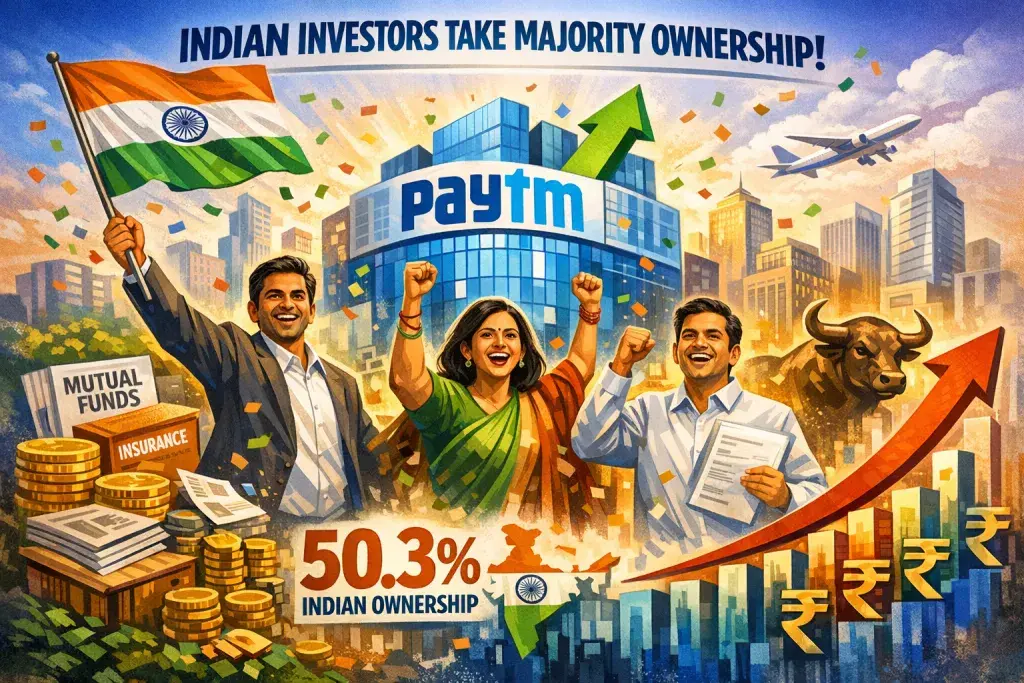
For the first time in its history, One 97 Communications — the parent company of Paytm — is majority-owned by domestic investors, with Indian shareholders collectively holding 50.3 per cent of the company as of March-end 2026. The shift is not merely symbolic. It signals a material reordering of the capital structure at one of India's most watched fintech firms, and it arrives alongside three consecutive quarters of profitability — a combination that has meaningfully altered the narrative around a company that spent years absorbing losses while building scale.
How Domestic Ownership Reached a Tipping Point
The move past 50 per cent was driven primarily by domestic institutional investors, whose combined stake reached a record 23.1 per cent in the March quarter — up 2.8 percentage points from the prior quarter and a substantial 9.1 percentage points higher than a year earlier. Mutual funds led the charge, with their aggregate holding climbing to 16.6 per cent from 14.3 per cent, while the number of funds invested in the company rose from 36 to 41. Motilal Oswal Mutual Fund, Mirae Asset, and Bandhan Mutual Fund were among those that continued to expand their positions.
Insurance companies added to the picture as well. Their combined stake edged up to 5.1 per cent from roughly 4.8 per cent, with Tata AIA Life Insurance and SBI Life Insurance among the firms increasing exposure. What makes this pattern significant is its breadth: it is not a single large bet by one institution, but a distributed accumulation across multiple categories of domestic capital — a pattern typically associated with conviction built on improving fundamentals rather than speculative momentum.
The Operating Story Behind the Ownership Shift
Investor confidence rarely moves in isolation from financial performance, and Paytm's numbers have provided a credible basis for the reallocation. The company reported a net profit of Rs 225 crore in the December quarter — its third consecutive profitable quarter — with revenue rising 20 per cent year-on-year to Rs 2,194 crore. EBITDA stood at Rs 156 crore, with margins at 7 per cent.
The merchant side of the business has been a particular source of strength. Subscription merchants crossed 1.44 crore, up 24 per cent over the year, a metric that matters because subscription-based merchant relationships generate recurring, predictable revenue — precisely the kind of revenue base that institutional investors value when assessing long-term earnings quality. Paytm's merchant revenues are, according to Bernstein, roughly twice those of its nearest competitor despite comparable merchant payment volumes, suggesting that the company has built a monetisation advantage that volume figures alone do not capture.
What Analysts Are Saying — and What It Means
Bank of America upgraded Paytm in recent months, citing its leadership in higher-monetisation segments and an improving profitability trajectory. The brokerage described the company as strong in business-to-business services and further along in its monetisation journey than peers, with a more diversified business mix and better margins — driven by performance in merchant payments and lending. It assigned a Buy rating with a target price of Rs 1,380.
Bernstein maintained an outperform rating, reinforcing the view that Paytm is further along the profitability curve relative to its competitive set. The convergence of views across two prominent international brokerages carries weight, particularly because both ground their assessments in the merchant business — the segment where Paytm appears to have built the most durable structural advantage.
For a company that weathered a turbulent period following regulatory disruptions to its payments bank operations in early 2024, the trajectory into 2026 looks markedly different. The rebuilding of institutional trust — reflected in rising domestic ownership, broker upgrades, and improving margins — suggests that what once appeared to be existential pressure has, through operational adjustment and capital discipline, become something closer to a resolved chapter. Whether the profitability trend holds across varied credit and payments cycles remains the key question. For now, the ownership numbers tell their own story.